
If a Bokashi bin has been part of your kitchen for years, the routine probably happens without much thought. Food scraps go into the bucket, Earth Bokashi is added, the lid goes back on and, once the bucket is full, it is left to finish fermenting.
But familiarity with the routine does not necessarily mean we know everything happening inside the bin.
Why can a well-fermented carrot peel still look remarkably like a carrot peel? Why does one Bokashi bin produce plenty of liquid while another produces almost none? Why can Bokashi handle food that is usually discouraged in an ordinary compost heap? And what actually happens once fermented food waste finally meets soil?
If you are new to Bokashi, learn along with us. You do not need to understand the microbiology to use the system well, but knowing what is happening makes the process easier to read and manage.
And if you have been using Bokashi for five, ten or even fifteen years, consider this a small challenge.
How many of these six do you already know?
One of the curiosities of Bokashi is that food often remains recognisable after fermentation.
Citrus peel still looks like citrus peel. Bread still looks like bread. Eggshells and small bones certainly have not disappeared.
That does not mean nothing has happened.
A Bokashi bin does not make finished compost. Instead, it ferments and stabilises the food waste in a sealed, low-oxygen environment.
That distinction matters.
With conventional composting, we expect visible decomposition. Bokashi works differently. Much of the physical breakdown happens later, once the fermented material moves into its next environment.
So, when you open a properly fermented Bokashi bin and can still identify yesterday’s leftovers, you are not looking at a failed compost heap.
You are looking at the end of Stage 1.
Home composters are commonly cautious about adding meat, fish, dairy and cooked leftovers to an open heap.
There are practical reasons. These foods can smell, attract flies or rodents and become troublesome if the heap is not managed well.
Bokashi changes the conditions.
Because food scraps ferment inside a sealed container, households can treat a much wider range of kitchen waste together, including cooked food, meat, seafood, dairy, citrus, eggshells and small bones.
That is useful because real dinner plates rarely leave behind a neat pile of vegetable peelings.
A scraped plate may contain rice, sauce, vegetables and a small piece of chicken. With Bokashi, those scraps can remain together as one food-waste stream rather than forcing the household to decide which bits may or may not suit an open compost heap.
However, the distinction is still important: a Bokashi bin accepts a wide range of food waste, not general rubbish. Plastic, glass, foil and packaging still stay out.
Not necessarily.
A Bokashi bin producing plenty of liquid may appear more active, but a bucket producing very little has not automatically failed.
The difference often comes down to what went into it.
Watermelon, tomatoes and other moisture-rich foods naturally release more liquid than bread, rice or drier leftovers. Temperature and season can also affect activity.
A bucket filled during a hot South African summer may therefore behave differently from one sitting in a cool garage during winter.
The amount of Bokashi liquid is not a performance score.
Instead, look at the system as a whole. Is the food fermenting rather than rotting? Does it have the characteristic fermented smell rather than a foul one? Is the lid sealing properly?
Those clues tell you far more than the quantity coming out of the tap.
The liquid itself remains useful. Once correctly diluted, it can be used as a soil drench, while undiluted Bokashi liquid can also be used in household drains.
Think of it as a useful by-product rather than proof that your Bokashi bin is working better than someone else’s.
Same kitchen. Same Earth Bokashi. Same person filling them.
Yet two Bokashi bins can behave quite differently.
The explanation is usually simple: no two batches of household food waste are identical.
One may contain more fruit and sugary leftovers. Another may be drier. One may fill quickly, while another takes several weeks. Temperature, moisture and how often the lid is opened can also vary.
Even the week’s menu makes a difference.
This is worth remembering because experienced users sometimes expect every batch to behave like the previous one.
Bokashi is a biological process. Biological processes respond to their environment.
As a result, the goal is not to make every bucket look identical. It is to provide the right conditions for fermentation and recognise the signs that the process is on track.
A full Bokashi bin is not necessarily a finished Bokashi bin.
The scraps at the bottom may already have been fermenting for weeks. The final layers, however, may have gone in only that morning.
Once you close the lid for the final time, fermentation continues inside the sealed bucket.
The microorganisms carried by the Earth Bokashi continue working on those newer food scraps, allowing them to move through the same fermentation and stabilisation stage as the material beneath them.
That is why Earth Probiotic recommends leaving a full bucket sealed for a further two weeks before the contents move on to their next stage.
The two weeks are not simply a waiting period. They give the most recently added food the time it did not have while the bucket was still being filled.
For households producing food waste every day, a two-bin system therefore makes practical sense. While one bucket completes fermentation, the second can take over in the kitchen.
During this resting period, keep the lid closed and the bucket out of direct sunlight.
Once fermentation is complete, the contents are ready to leave the bucket.
But they are still not finished compost.
Which brings us to the part of the Bokashi process many of us use without really thinking about what happens next.
Most experienced Bokashi users know the instruction.
Add the fermented material to a compost heap. Bury it appropriately in soil. Use it in a soil factory. Move it into another suitable secondary system.
The practical step is simple enough.
What we talk about less often is why the material changes so dramatically after it leaves the Bokashi bin.
Inside the sealed bucket, the food has fermented rather than fully decomposed. Much of its physical structure remains intact.
Once that fermented material enters soil or a composting environment, the conditions change.
Oxygen becomes available. Soil organisms encounter the organic material. Microbes, earthworms and other decomposers can begin working on it.
This is when the more obvious physical breakdown starts.
Food scraps that remained recognisable inside the Bokashi bin can begin breaking down much more visibly once they enter the right secondary environment.
That is why Bokashi and composting should not be viewed as competing systems.
They can be consecutive stages of the same journey.
Bokashi treats and stabilises the food waste first. Soil organisms and composting processes continue the transformation afterwards.
Seen this way, the bucket under the kitchen counter is doing something quite specific. It is not trying to create finished compost.
It is preparing mixed household food waste for what comes next.
Perhaps the clearest sign that Bokashi has become part of a household is how ordinary the routine eventually feels.
Scrape the plate. Add the food scraps. Sprinkle the Earth Bokashi. Close the lid.
For experienced users, understanding more about what is happening behind those familiar steps adds another layer to a system they may have been using for years.
For newcomers, it removes much of the uncertainty.
And there is a wider value in that understanding.
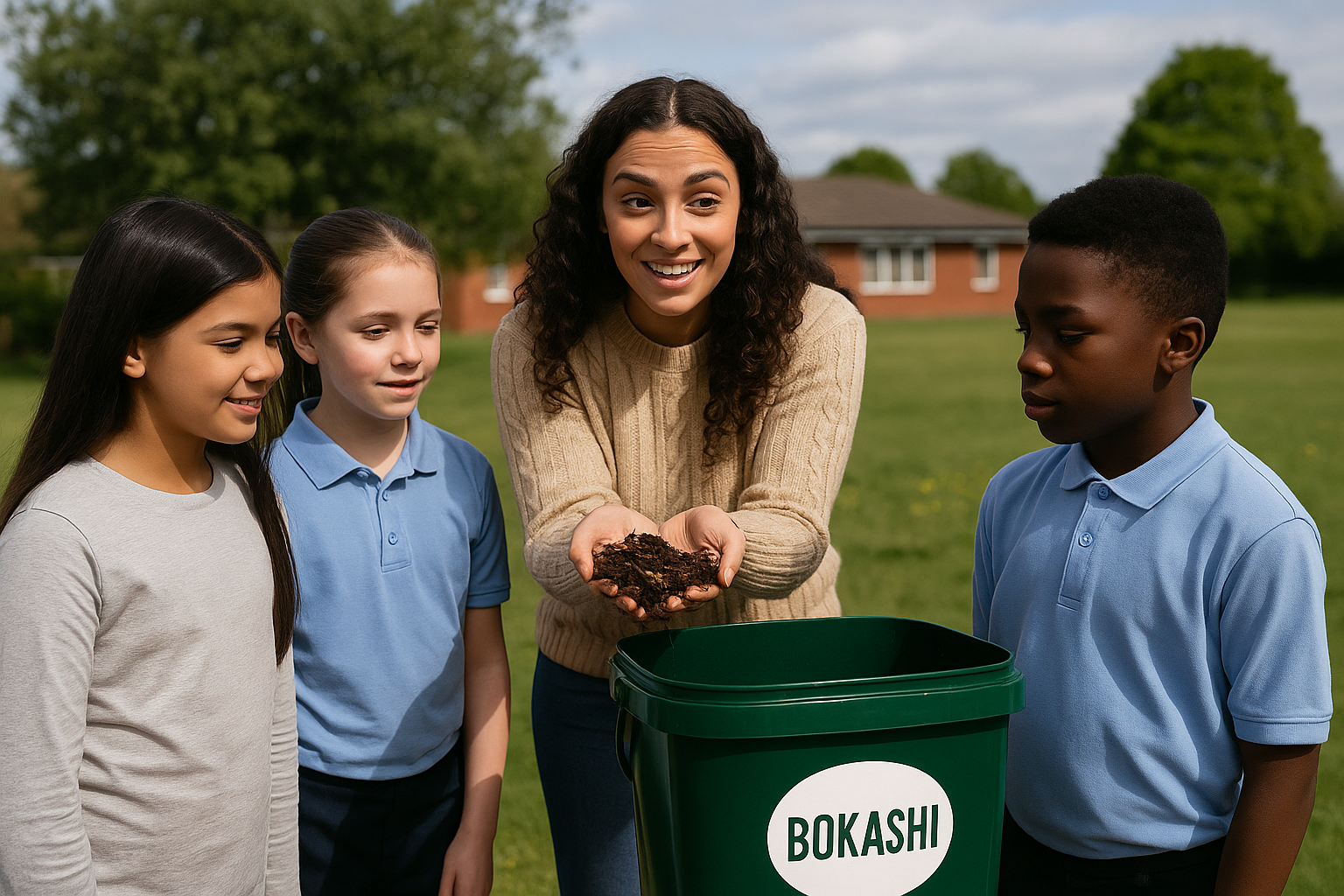
Children notice where food scraps go. Families become more conscious of what they throw away. Something that once disappeared automatically into the general bin begins to be recognised as organic material with another stage ahead of it.
No household has to be perfect.
The important shift is simply to understand that food waste does not stop mattering once dinner is over.
Small habits repeated at home have a way of becoming the habits the next generation considers normal.
And choosing a better next step for our food scraps is a good one to pass on.